

Our Latest Blogs
Our aim was to make technical information about solar energy easily accessible to our audience by presenting it in a straightforward and conversational language.
Contact Us
August 10th, 2026
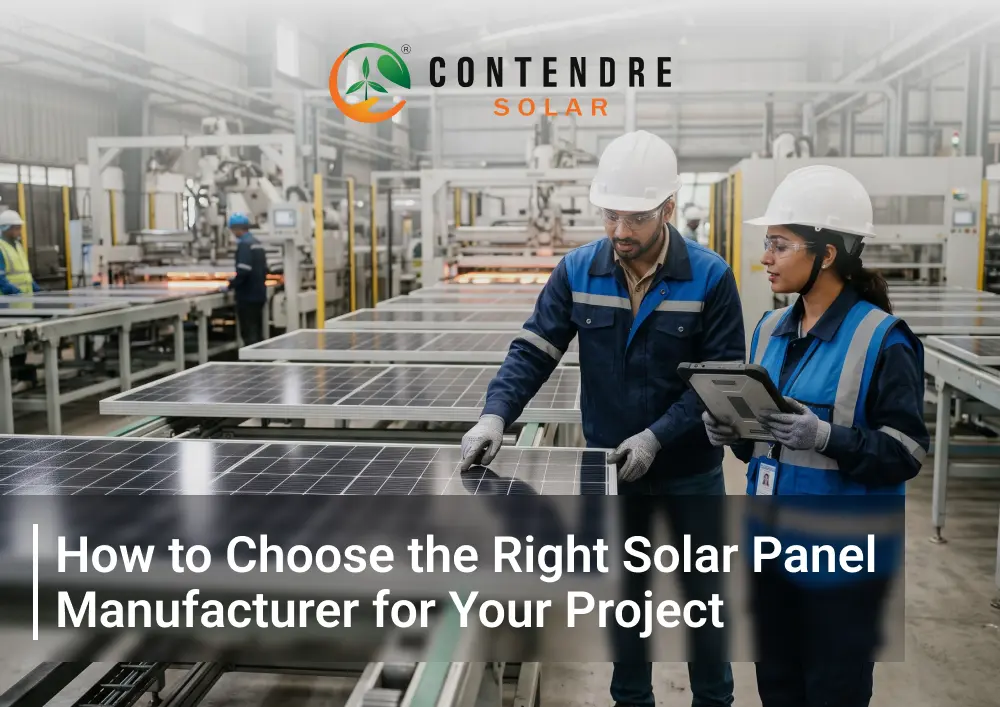
One of the most critical components of any solar project is deciding on the solar panel manufacturer, and this step is routinely executed as a mere formality. The buyer checks price and wattage, signs an agreement, and continues. The true disparities become apparent only after many years, when one system continues to deliver near-expected power output and another system has a performance substantially below expectations.
That difference usually comes down to the manufacturer-literally the way the module was physically produced, including how precisely the cells match each other, the longevity of lamination, and where in the production process quality control actually occurred.
This guide explores how you can actually evaluate solar module manufacturers.
When you observe a failure on a solar panel, that rarely occurs suddenly. The output usually declines over the course of five, ten, or even more years, and is almost invariably due to the manufacturing process, not the installation.
A series of mismatched cells puts uneven stress on a string; lamination eventually lets moisture seep inside; a seal on the junction box fails as a result of repeatedly being heated and then cooled.
That's why the solar panel manufacturer is equally as important as the system design surrounding it. A solar panel company that only checks the quality during the final packaging stages is selling a different product than one that tests every stage (stringing the cells, lamination, module testing).
The manufacturing quality problem doesn't remain a small one when significant investment is made in solar. The low quality manifests as reduced production year after year over the lifetime of the equipment.
Spec sheets can help in comparing one device against another, but they don't tell the complete story. A handful of other factors, such as choosing a reliable solar panel, are at least as important for ensuring consistent performance and long-term value.
Together, these factors separate a solar panel manufacturer worth a long-term relationship from one that's simply selling modules.
Solar panel technology varies significantly between manufacturers, and these differences become more important as a project grows in scale.
Cell technology is where it all starts.
N-Type TOPCon cells tend to provide the highest efficiency values, which today can usually reach between 22-23% for current modules, and they provide good results under high temperatures.
P-Type PERC is a more cost-effective system that performs reliably in different array installations. The optimum selection depends on the available roof/land area and the cost and life expectancy of when the modules should still be delivering rated output.
Wattage and efficiency are measures of the power-producing capacity of any given space, and these factors are only critical on rooftop applications.
Degradation rate, on the other hand, is often overlooked and has a very real financial component; A module that degrades at 0.55% each year against one degrading at 0.35%each year represents a discernible gap in production at the 20-year mark.
If a company only supplies one type of panel, there are limitations in what they can offer. The vast majority of reputable commercial solar pv panels suppliers make many more products, since varied technology is required in many differing projects.
Matching panel type to actual site conditions, roof orientation, available space, and ground reflectivity typically delivers better long-term output than simply choosing the highest wattage figure available.
A panel's specifications describe what it's supposed to do. The manufacturing facility behind it determines whether it actually will.
Solar panel certifications matter because they're based on testing, not claims.
IEC 61215 covers design qualification, confirming the module has passed environmental and mechanical stress tests like thermal cycling and hail impact. IEC 61730 covers safety qualification, addressing electrical insulation and fire safety. ISO 9001 confirms a structured quality management system across manufacturing, not just the finished product. Export markets may require additional regional certifications, and a manufacturer supplying multiple countries should be able to confirm which ones apply where.
A manufacturer that can provide this documentation on request, tied to the specific product being quoted, is one worth taking seriously.
The relationship with a manufacturer continues well after delivery.
Warranties can be quite straightforward; most companies promise 10- to 12-year product warranties and 25-year performance warranties to the customers. What's trickier to compare at the outset is when an actual claim needs to be made: will the response be prompt?
And is the manufacturer involved with the claim or is it handled by a distributor?
Ask for an instance of a successfully processed claim; if they don’t have one to offer you, make a note.
Supply reliability deserves the same approach. Ask for the manufacturer's average lead time on an order matching your project's size, and confirm whether it's contractually committed or just an estimate.
The right manufacturer depends on what the project actually needs.
While the benefits of selecting the right manufacturer are not so easy to see initially, over the system's life they do become very significant.
A reliable solar panel company isn't just selling a product. It's removing one of the largest variables in how the project performs over the next two decades.
Checklists don’t replace judgment, but they can help avoid many mistakes in a rushed decision.
Contendre Solar manufactures N-Type TOPCon and P-Type PERC modules in-house, at a 1 GW facility, with quality checks applied at cell stringing, lamination, electroluminescence inspection, and IV curve testing, not only at final inspection before dispatch. The company behind these modules is part of the Contendre Group - a business that had a discipline around manufacturing, long before solar was their expertise.
For developers and EPCs weighing the best solar panel manufacturers, the deciding factor is rarely the number on a datasheet. It's whether the module performing today still performs the same way in years later.
That kind of consistency, batch after batch, is what Contendre Solar's manufacturing process is built to deliver.
A suitable solar panel manufacturer is not the one that comes in with the lowest price and the biggest wattage claim. They are the one whose panels consistently deliver nearly expected output years after they go on roofs. That requires manufacturing discipline audited at all levels of the product’s life cycle, certifiable and certified accreditations, and verifiable evidence you can check out through an actual third party.
A solar panel making company you should work with should be prepared to be put through this test - on all the components.
